The ESAT Move Register · A4 book · PDF
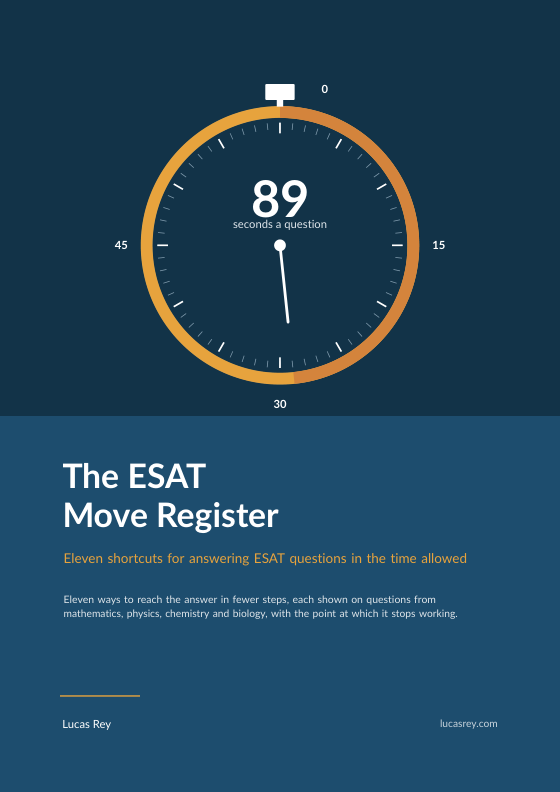
The methods I teach my ESAT students, in one book
Shortcuts for the ESAT, each shown on ESAT style questions, with the point at which it stops working.
By Lucas Rey MRes (Cantab) · Free worked solutions and practice questions for every candidate at lucasrey.com/teaching/esat













Not sure where to start? 3 places to go
Start with your question
Why visitors arrive: Looking for a book that makes ESAT questions faster to answer
Your question: What is in the ESAT Move Register, and what does a page of it look like?
You may also be asking
- What does each worked example contain?
- Where are the free ESAT practice questions?
- Which edition do I need?
- Are there mock papers for a school?
Where to go next
- ESAT overview hub: The free mock papers, practice questions and worked solutions
- ESAT specification: Every sub-topic the ESAT can examine, module by module
- Mock papers for schools: Complete ESAT mock papers for a whole cohort, with a free sample pack
Three editions, and every later edition included
Student edition
£39
Licensed to one student for their own study. Not licensed for use by tutors, schools or colleges.
Tutor edition
£99
The same PDF, licensed to one private tutor: you may print pages for your own students and use the examples in your lessons. Not licensed for schools or colleges.
School edition
£199
The same PDF, licensed to one school or college department: its teachers may use the examples in lessons and print pages for students of that school. The file stays with staff.
Each copy bought on our website gives Pro free to a student who couldn't otherwise cover the cost. How it works The scheme's terms
- All three editions are the same book: 460 A4 pages as a PDF, written by me, Lucas Rey.
- They differ in the licence.
- Each is one payment.
- The Student and Tutor editions come with a free week of my ESAT practice pass, switched on for the email you pay with.
- The moment you pay, the PDF is on your own order page, and it stays there.
- The book is revised as examples are added, explanations are sharpened and anything found wrong is corrected, and every later edition appears on that same page at no extra cost, whichever edition you bought.
- A shared copy stays at the edition it was shared at, and a bought copy keeps receiving the new ones.
For schools
For a teacher or a school preparing a whole cohort, there are complete ESAT mock papers.
- Print-ready PDFs for a whole year group, with worked solutions and mark schemes.
- A free sample pack is published on this site, with nothing to register for.
- An unseen pack can be written for a single school, and is never issued to another.
What you get
- 11 moves, each a way of reaching the answer in fewer steps than the usual method, with its tips and a drawing that shows it at a glance.
- 90 worked examples across Mathematics 1, Mathematics 2, Physics, Chemistry and Biology.
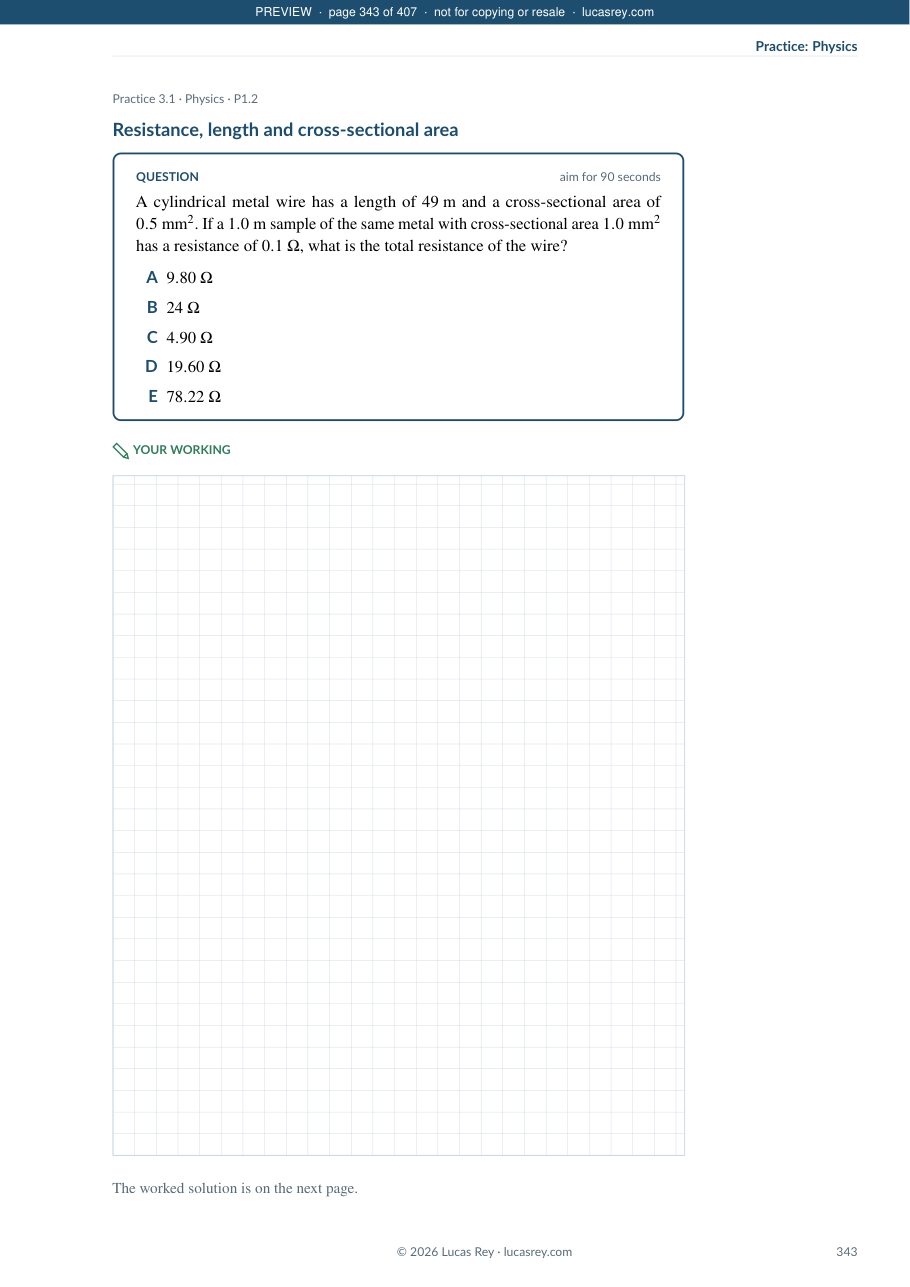
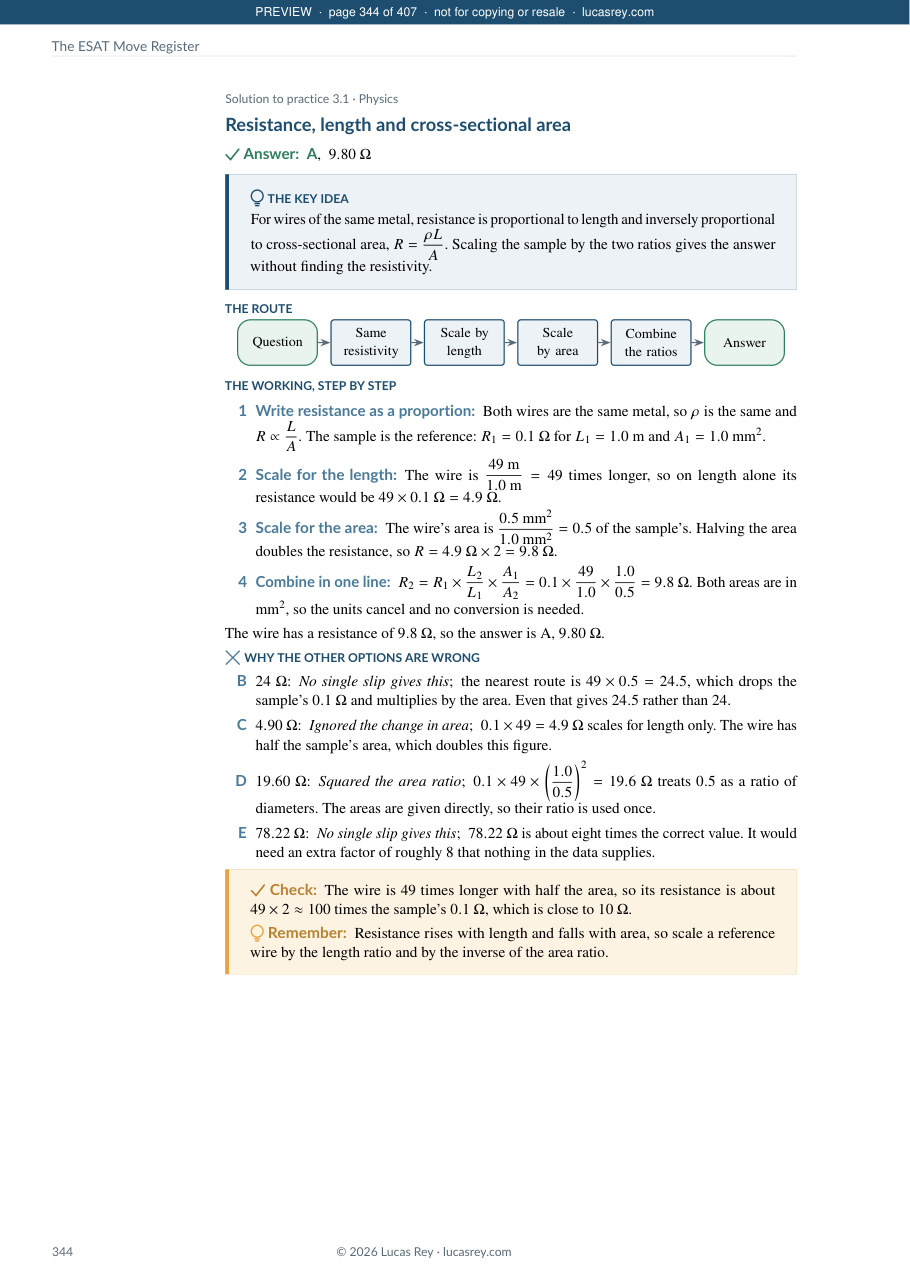
- 50 practice questions, ten for each module, each on its own page with room to work and a full worked solution overleaf.
- 34 habits that apply to every question, a chart for choosing a move and an error log.
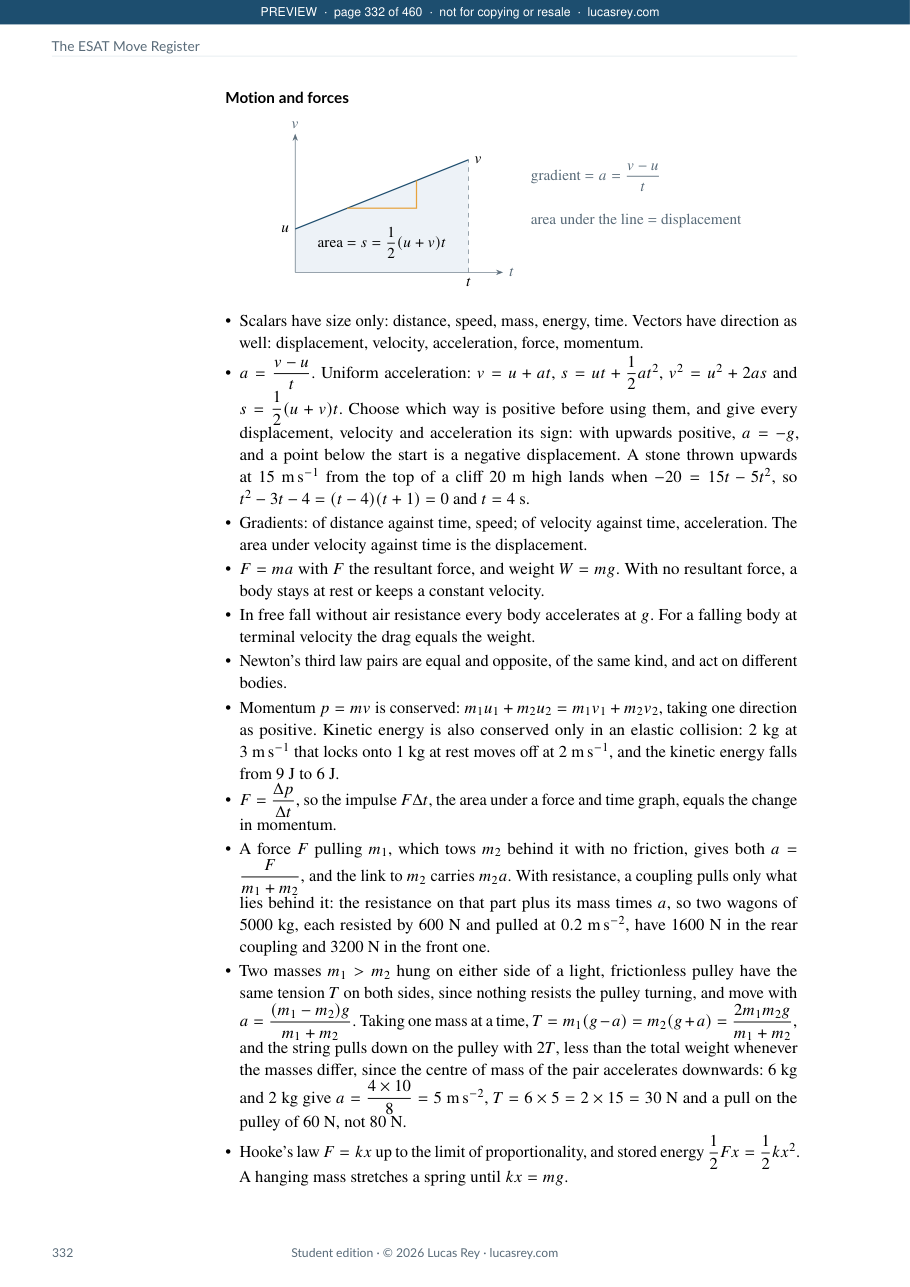
- A formula notebook with every formula and fact the ESAT syllabus expects you to recall, module by module, from Mathematics 1 to Biology, and the results beyond the syllabus that shorten real questions. The paper gives no formula sheet, so the notebook gathers them in one place to learn.
- Every later edition of the book as a PDF, at no extra cost, on the same page.
Why a book, when a chatbot answers anything
A chatbot answers any ESAT question correctly, free, in seconds. It has read every correct solution ever published and almost none of the wrong ones, because students do not publish their mistakes. I have spent years sitting with candidates while the wrong ones happened, asking them what they thought they were doing, and writing it down after every lesson. Each edition of this book takes whatever is new in those notes and adds it.
That is what a model cannot reach, and everything else here comes out of it. On a multiple choice paper the options are the values a particular slip produces, which is how a distractor gets written. This book names the slips I keep seeing, two percentage changes added rather than multiplied, a repeated loss treated as one multiple, a ratio turned upside down, and works each one through every example: 497 wrong values with the arithmetic that reaches each. A candidate who recognises the slip sees the trap before doing any arithmetic.
A paper allows 40 minutes for 27 questions, or about 89 seconds each. I timed the usual method across every worked example in this book and it averages 63 seconds, so 71 per cent of the budget goes on one question, twenty seven times in a row, before a single hard one. The moves reach the same answer in about 30. Candidates are rarely short of correct methods and often short of time, and a chatbot hands them a correct method by the longest route it knows.
Every one of the 90 examples also changes its question until the move stops being true, and shows the different answer it then gives. A shortcut you cannot falsify is worse than no shortcut, because under time pressure you will reach for it in the one case where it does not hold.
The 11 moves at a glance
Each move opens with a drawing that shows the idea before any example. These are the eleven drawings, as they appear in the book.
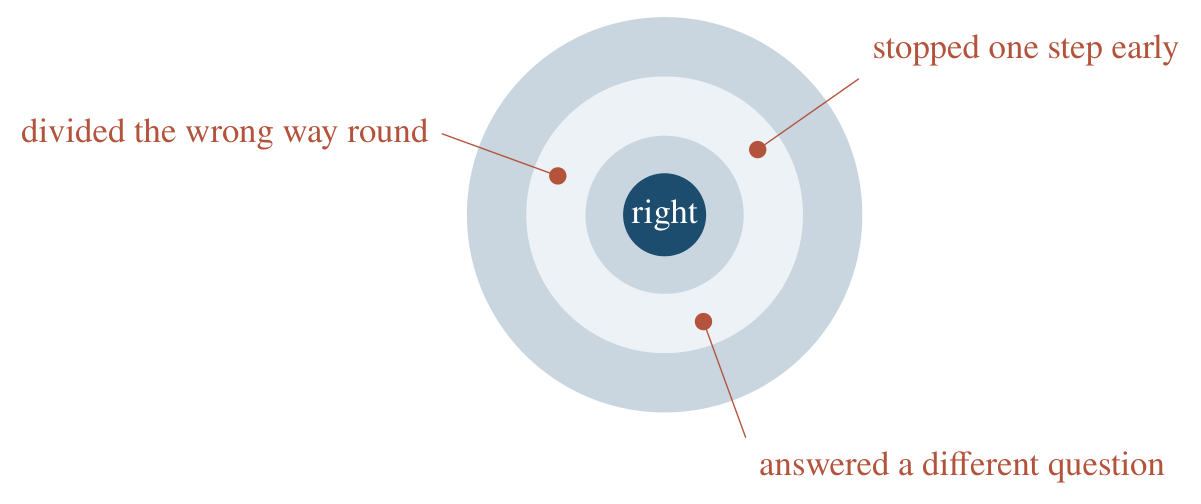
Move 1: Know which wrong answers a slip produces, and recognise themEach wrong option is one slip away from the answer. 
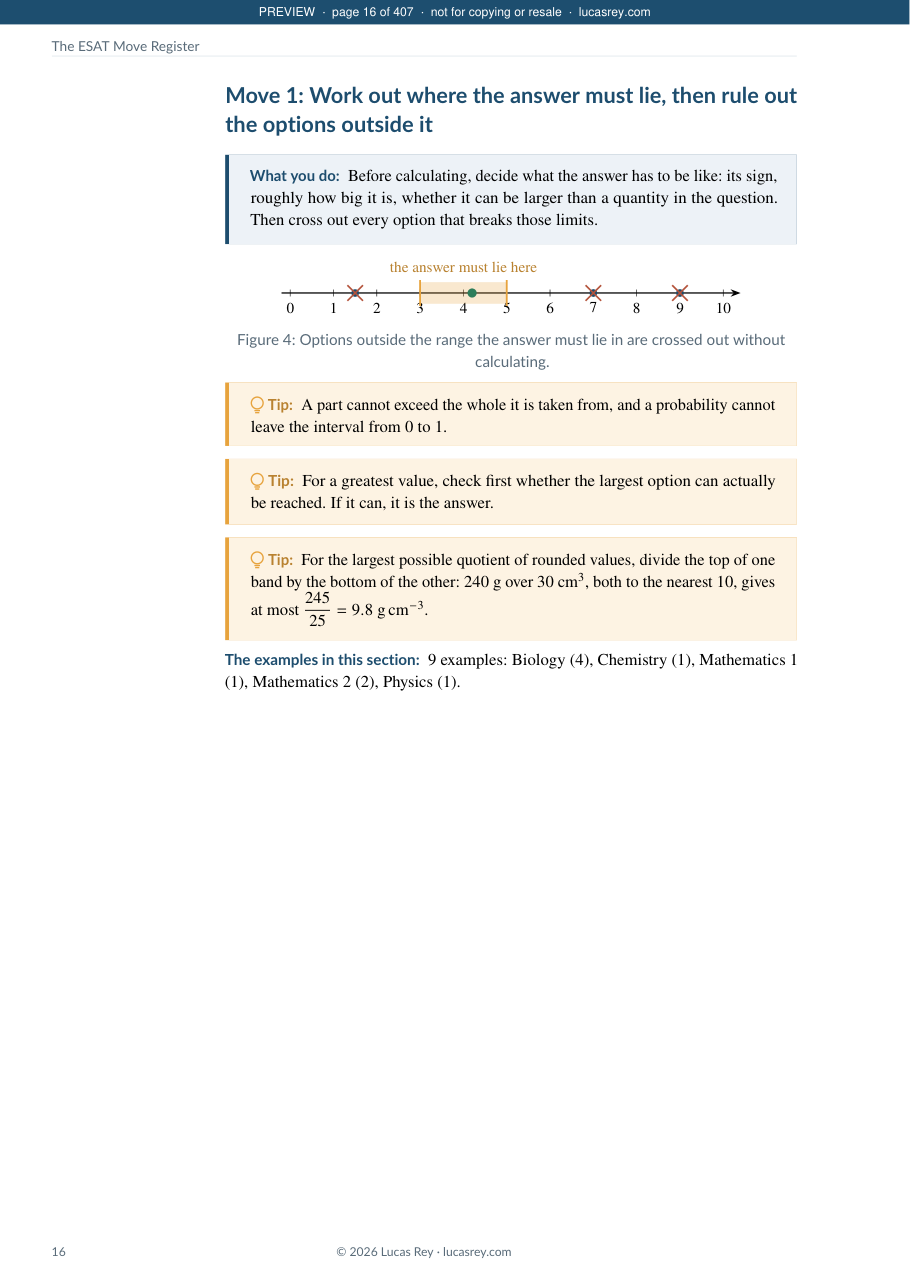
Move 2: Work out where the answer must lie, then rule out the options outside itOptions outside the range the answer must lie in are crossed out without calculating. 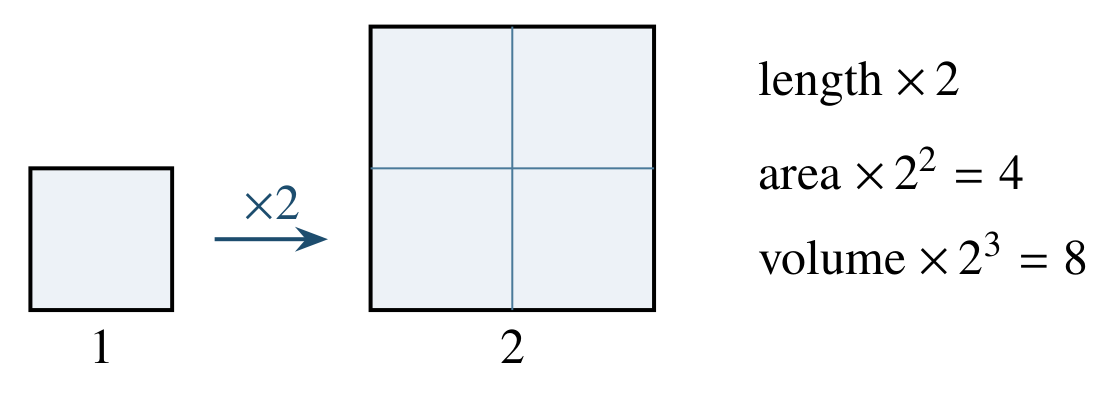
Move 3: Compare two cases through their ratio, without working out either in fullDoubling every length multiplies areas by 4 and volumes by 8. 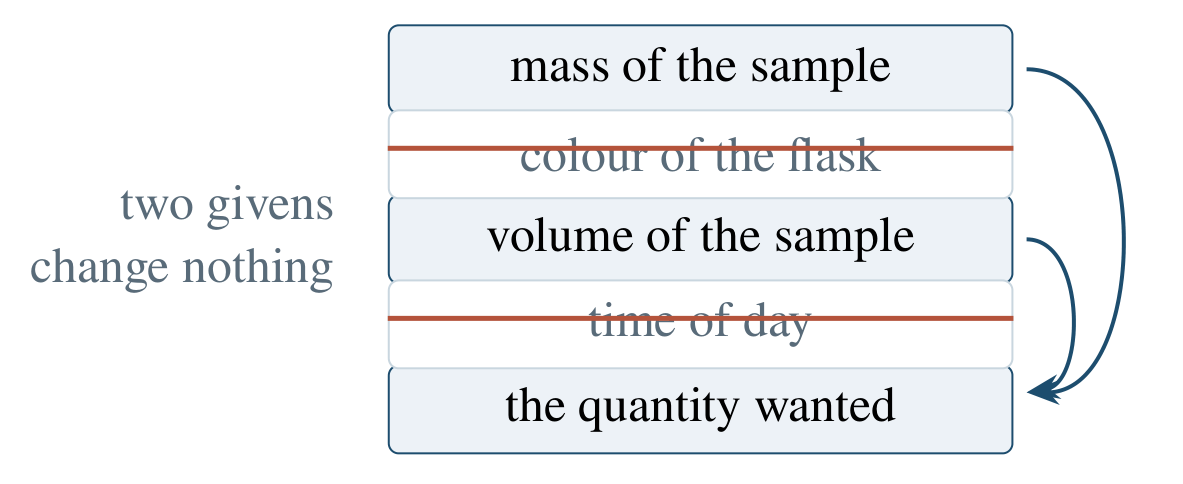
Move 4: Find which given values can change the answer, and set the rest asideOnly the givens that appear in the formula can change the answer. 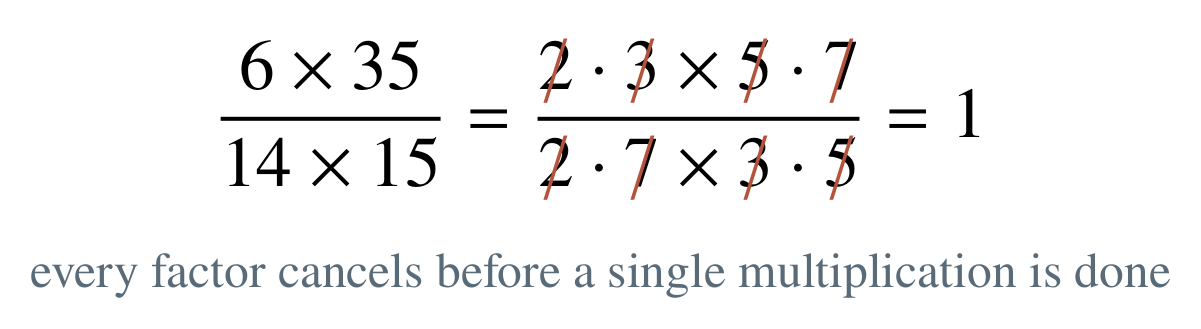
Move 5: Cancel in symbols first, and put the numbers in lastEvery factor cancels before any multiplication is done. 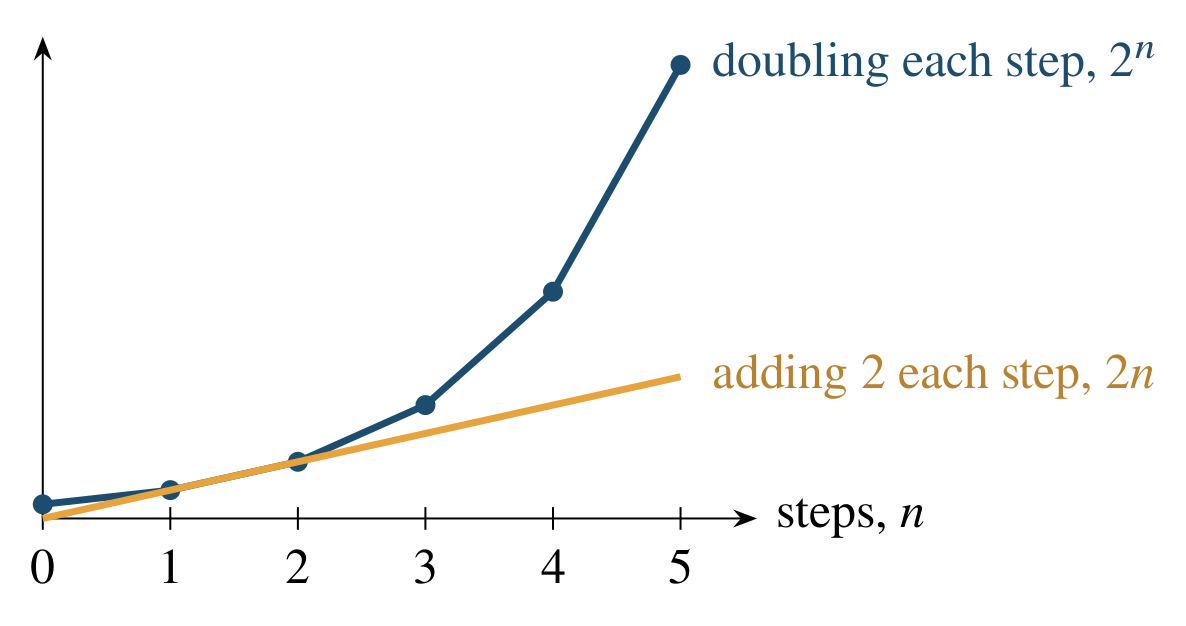
Move 6: When the same factor repeats at every step, use a power instead of multiplyingDoubling at each step grows as a power; adding a fixed amount grows as a multiple. 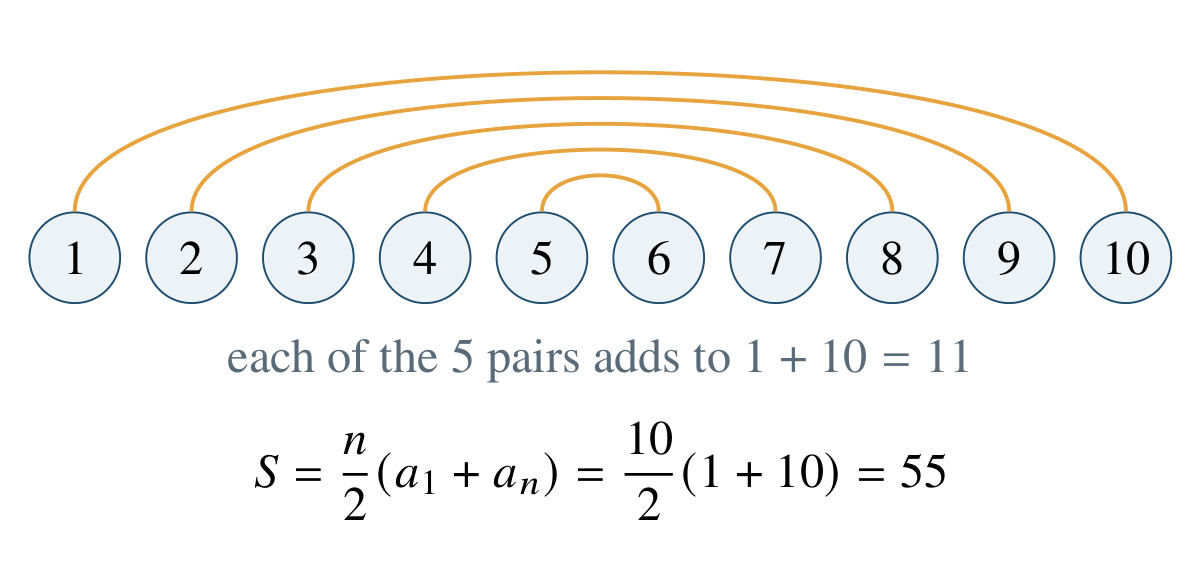
Move 7: Look for something special in the numbers before using the general methodPairing the ends of an evenly spaced list gives equal sums. 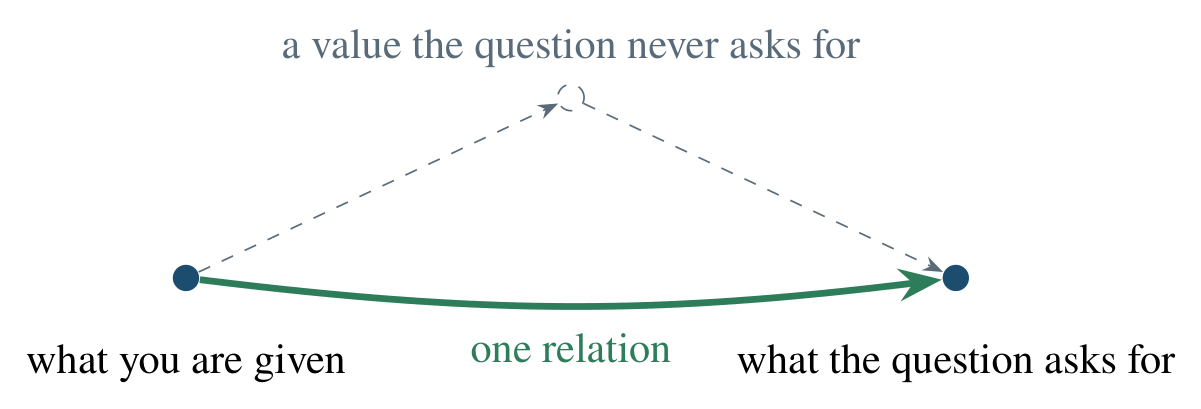
Move 8: Go straight to the quantity the question asks forOne relation reaches the quantity asked for without the value in between. 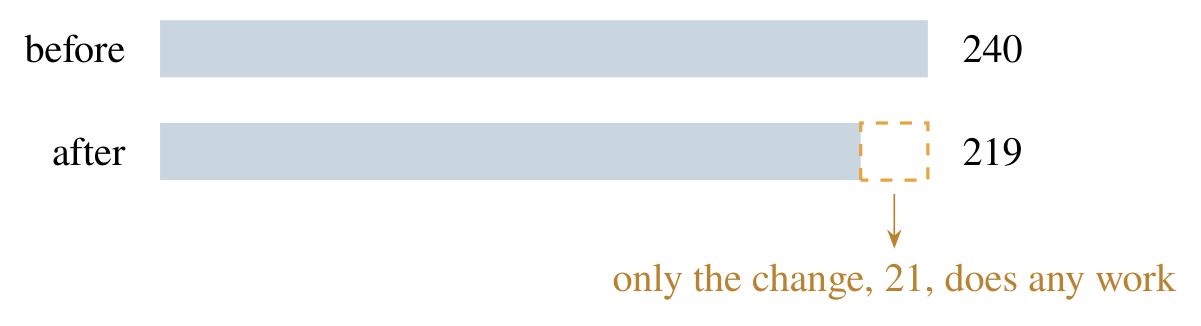
Move 9: Work out only what changes, not both situations in fullOnly the difference between the two states does any work. 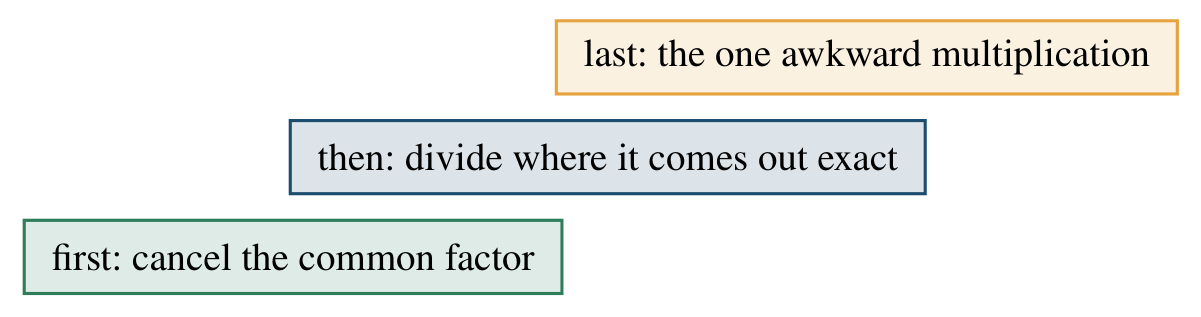
Move 10: Do first the step that keeps the numbers small and exactThe same three steps, in the order that keeps the numbers small. 
Move 11: Work in one convenient unit and convert once, at the endOne conversion at the end, in place of one at every step.
What each example contains
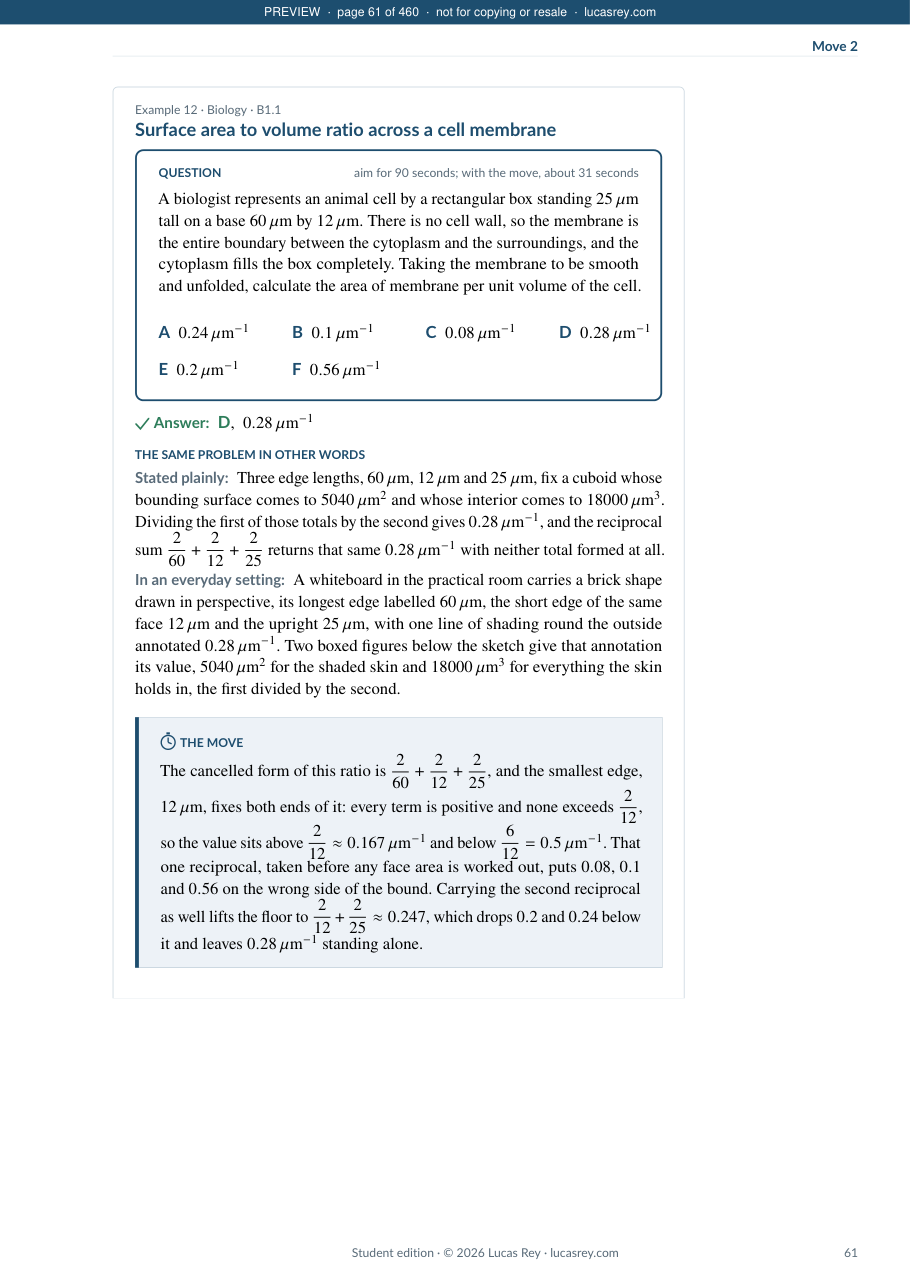
- An ESAT style question with five to eight lettered options.
- The answer, and the problem stated plainly and in one other setting.
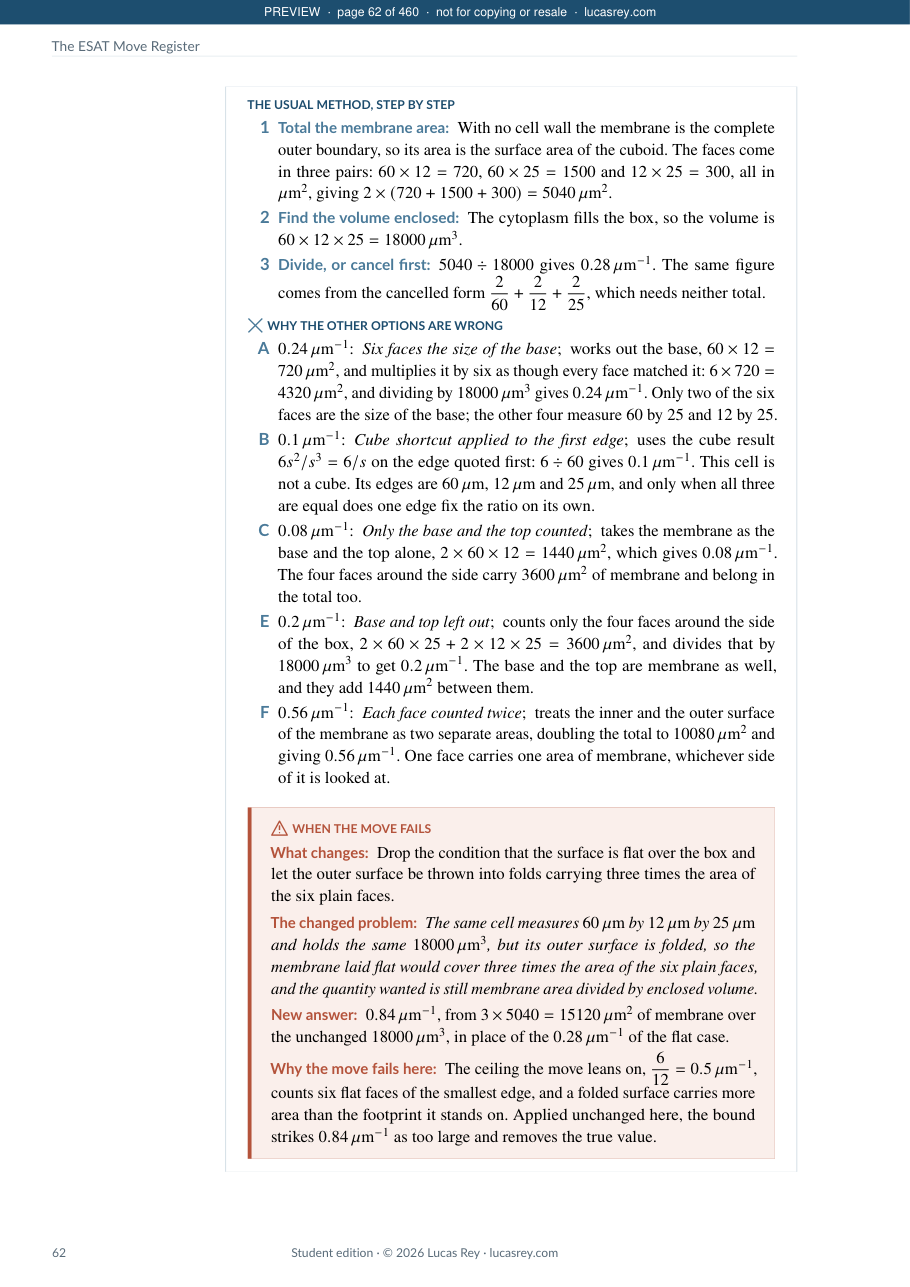
- The move, and the usual method step by step.
- The slip that produces each wrong option.
- A changed problem on which the move fails, with its new answer.
- An exercise with a worked version to check against.
Preview
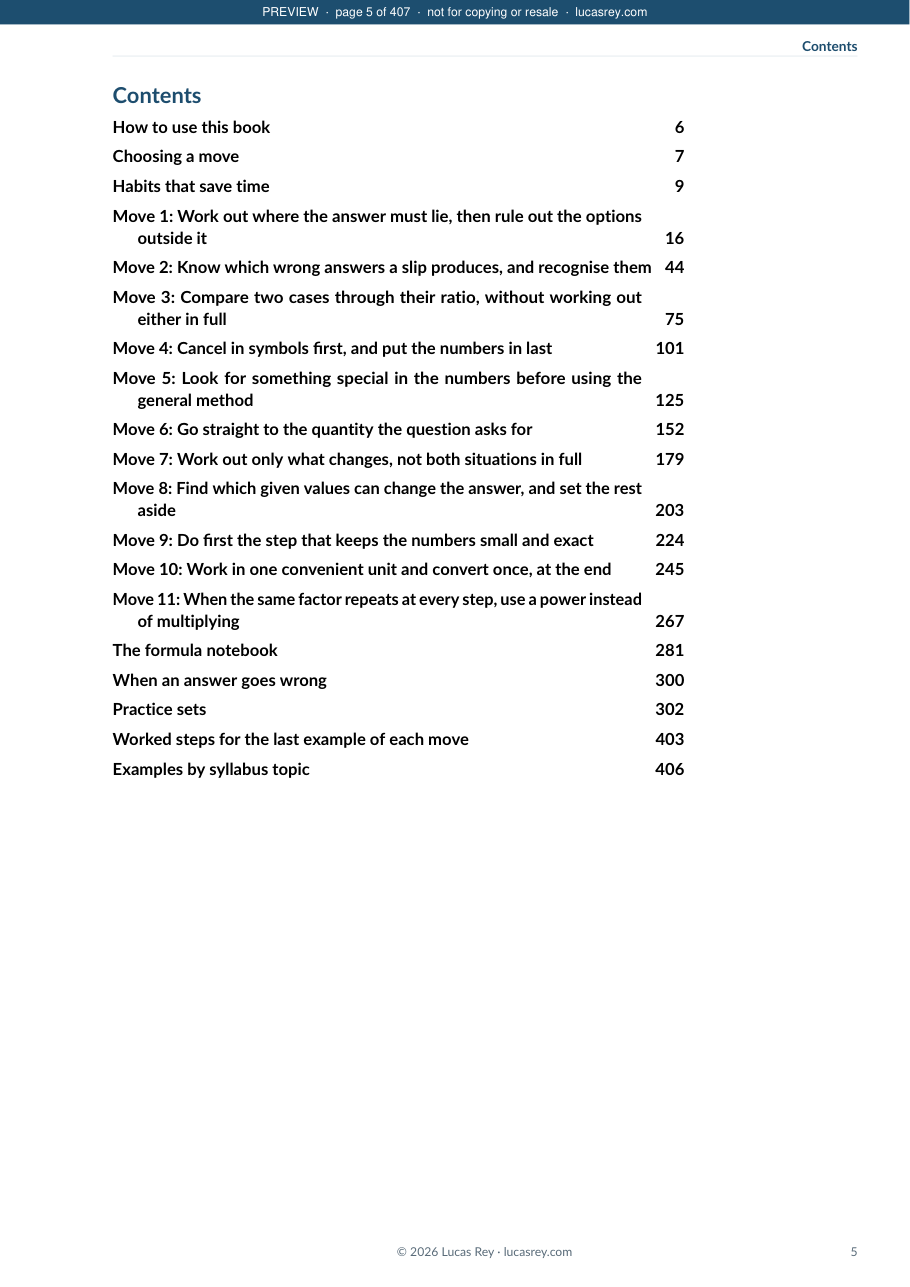
Eight of the book's 460 pages, each marked as a preview: how the book is laid out, how a move opens, a worked example with the usual method beside it, a page of the formula notebook, and one practice question with its solution. It is not the whole book.
Questions I am asked
Which edition do I need?
If you are preparing for the ESAT yourself, or buying the book for a candidate, the Student edition. If you teach the ESAT and want to print pages for your students or use the examples in lessons, the Tutor edition, which licenses one private tutor. If you are buying for a school or college, the School edition, which licenses one department and its teachers: the Student and Tutor editions are not licensed for schools or colleges. The pages are the same in all three.
How do I get the book after paying?
Payment is taken by Lemon Squeezy, which sells the book as merchant of record and handles the VAT, so its name is the one on your receipt. The checkout asks for your email address, and the PDF is on your order page as soon as the payment goes through. That page is yours to come back to, and the receipt email carries a button that takes you to the book.
What happens when a new edition comes out?
It appears on the order page you already have, at no extra cost, whichever edition you bought. There is nothing to ask for and nothing to forward. A shared copy stays at the edition it was shared at, and a bought copy keeps receiving the new ones.
How is the book different from the free material on this site?
The practice questions and worked solutions at lucasrey.com/teaching/esat are questions with their solutions, and they stay free. The book teaches the moves that make a question faster, compares each with the usual method, and shows where each one fails.
Does the book have the formulas I need?
Yes. The formula notebook holds every formula and fact the ESAT syllabus expects you to recall, module by module: Mathematics 1 and 2, Physics, Chemistry and Biology, from the equations of motion and the circle theorems to the chemical tests and the hormones of the menstrual cycle. Each module ends with results beyond the syllabus that shorten real questions. The ESAT gives no formula sheet, so every line is one to know by heart.
Which modules does it cover?
Mathematics 1, Mathematics 2, Physics, Chemistry and Biology. The index by syllabus topic lets you work through the modules you sit.
Is the book connected to the ESAT's organisers?
No. The ESAT is administered by UAT-UK. This book is independent of UAT-UK and of the universities that use the test, and is not endorsed by them. Every question in it is original, and no past paper is reproduced in it.
Who wrote it?
I wrote it from a great many hours of one to one teaching, where an explanation that did not work was replaced with one that did, and where the slips behind the wrong options were first seen.
New editions and new books
New editions and new books are announced on the ESAT preparation list.
© Lucas Rey: the book and the preview pages shown here may not be copied, shared or resold without written permission.