ESAT practice · Chemistry
ESAT Chemistry Practice Questions by Topic
I teach the ESAT, and these are the Chemistry questions I publish for practice, each filed under the topic and the skill it tests, with a worked solution that names the mistake behind every wrong option. 10 questions are worked on this page; 20 more sit in the four sample papers and are linked under the same skills. Every module is on ESAT practice by topic.
Sit it, do not just read it
Take ESAT practice by topic Chemistry under the clock
10 questions, and the clock is set to 14:49: the official pace of 40 minutes over 27 questions, applied to these 10.
- 10 questions, one at a time
- 14:49 on the clock, then it marks itself
- The worked solutions below are hidden while you sit it
- Marked in your browser. No account, nothing sent
You have an unfinished attempt on this device.
You sat this on this device before.
There is no negative marking on the ESAT. If you do not know, narrow it down and commit to a guess.
C1 Atomic structure
C1.2 Give the relative mass and charge of a proton (1, +1), a neutron (1, 0) and an electron (negligible, -1), and use them to explain why almost all of an atom's mass is in its nucleus.
Worked in the sample papers: Paper 1, question 1 · Paper 2, question 1 · Paper 3, question 1 · Paper 4, question 1.
C1.3 Define atomic number (the number of protons) and mass number (protons plus neutrons), and read both from an element's standard symbol.
Question 1
Back to top ↑A revision card records one ion and its particle counts. An ion $\mathrm{X}^{2+}$ contains $34$ neutrons, and $28$ electrons surround its nucleus. Which number would be written at the top left of its symbol in standard notation?
Key Idea (💡): Standard notation stacks two counts in front of the symbol and they are not interchangeable: the lower number is the atomic number, a count of protons, and the upper number is the mass number, a count of protons and neutrons together. Electrons appear in neither. In a neutral atom the electron count would hand you the proton count for free, but an ion is charged precisely because those two no longer match, and the charge measures the mismatch exactly. So the route is always the same: apply the charge to the electron count to get the protons, then add the neutrons to get the mass number.
Shortcut rehearsed: Add the lost electrons back before counting protons
ESAT specification (UAT-UK): C1.3 - Know and be able to use the terms atomic number and mass number, together with standard notation...
Reveal the answer & worked solution: commit to an option first
Correct Answer: B. 64
Fastest Approach (🚀):
Settle the charge step before touching the arithmetic, because the sign alone decides it. A positive ion has lost electrons and therefore holds more protons than electrons; a negative ion has gained them and holds fewer. Once the $30$ protons are on the page the rest is a single addition, and any option no larger than the $34$ neutrons can be struck out before it is done, since the protons take up the rest of the mass number.
Step-by-Step Breakdown:
1. Turn the electron count into the atomic number
Charge is the count of electrons missing or spare. This ion has lost two electrons relative to the neutral atom, so it carries two electrons fewer than protons:
$Z = 28 + 2 = 30$
That proton count is the atomic number, the figure written at the bottom left.
2. Add the neutrons to reach the mass number
The mass number totals protons and neutrons and nothing else, because an electron is far too light to register in it:
$A = Z + n = 30 + 34 = 64$
Sanity check: read the notation back. From $^{64}_{30}\mathrm{X}$ the neutrons are $64 - 30 = 34$, and an ion of charge $2+$ built on $30$ protons holds $30 - 2 = 28$ electrons. Both match what was measured.
The key is $64$.
Why the Other Options Are Wrong (❌):
Common Mistake (⚠️):
Treating the ion as though it were neutral. Only in a neutral atom does the electron count double as the proton count; this ion has lost two electrons, so its $28$ electrons and its $30$ protons differ by $2$, and using $28$ as the atomic number shifts the mass number by that same $2$.
Takeaway (📌):
Charge first, then add. The charge turns the electron count into the proton count, $28 + 2 = 30$, and the mass number is that proton count plus the neutrons. Electrons never enter a mass number at all.
Question 2
Back to top ↑A card in a set of nuclide flashcards is labelled $^{108}_{47}\mathrm{Ag}$, giving a nuclide of silver in standard notation. How many neutrons are in one atom of this silver?
Key Idea (💡): Standard notation stacks two counts in front of the symbol and they are not interchangeable. The lower number is the atomic number, which counts protons alone and fixes the identity of the element. The upper number is the mass number, which counts protons and neutrons together, because electrons are far too light to contribute to it. Neutrons are therefore never printed directly: they are the part of the mass number that the atomic number does not account for.
Shortcut rehearsed: Neutrons are the upper number minus the lower one
ESAT specification (UAT-UK): C1.3 - Know and be able to use the terms atomic number and mass number, together with standard notation...
Reveal the answer & worked solution: commit to an option first
Correct Answer: A. 61
Fastest Approach (🚀):
Any option that is at least as large as the mass number $108$ can go immediately, because the protons must take up part of it. That removes two of the five before any subtraction is done.
Step-by-Step Breakdown:
1. Read the two numbers off the label, then take the difference
The label gives the nuclide as $^{108}_{47}\mathrm{Ag}$. The lower figure is the atomic number, $Z = 47$, and it counts protons only: it is what makes the atom silver rather than anything else. The upper figure is the mass number, $A = 108$, and it counts protons and neutrons together, because the electrons are far too light to register in it. Neutrons appear in $A$ and nowhere else on the label, so removing the protons from the mass number leaves them:
$n = A - Z = 108 - 47 = 61$
Sanity check: the neutron count cannot equal or exceed the mass number, since the protons take up part of it, so $108$ and $155$ are impossible before any arithmetic is attempted.
The key is $61$.
Why the Other Options Are Wrong (❌):
Common Mistake (⚠️):
Quoting the upper number as the neutron count. The mass number is protons and neutrons added together, not neutrons alone, so $108$ silently includes the $47$ protons and overstates the neutrons by exactly that many.
Takeaway (📌):
The bottom number identifies, the top number weighs. Protons come straight from the bottom number, neutrons only from the difference, and nothing on a nuclide label ever counts neutrons for you.
The same skill in the sample papers: Paper 1, question 2 · Paper 1, question 5 · Paper 2, question 2 · Paper 2, question 5 · Paper 3, question 2 · Paper 3, question 5 · Paper 4, question 2 · Paper 4, question 5.
C3 Chemical reactions and equations
C3.1 Explain that a reaction makes new substances by reshuffling atoms and their electrons, while every nucleus survives untouched.
Question 3
Back to top ↑A sealed flask holds only ammonia $\mathrm{NH_{3}}$ and oxygen $\mathrm{O_{2}}$ in the atom counts shown. A spark gives water $\mathrm{H_{2}O}$ and nitrogen $\mathrm{N_{2}}$ as the only products. How many molecules then fill the flask?
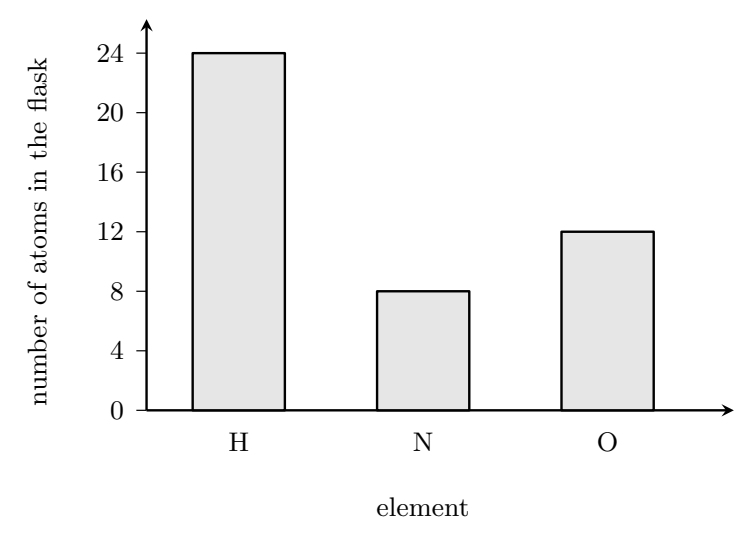
Key Idea (💡): A chemical reaction rearranges atoms and their electrons, and it creates and destroys no nuclei. In a sealed vessel the number of atoms of each element is therefore identical before and after the reaction, so the products can be found by sharing those atoms out among the product formulae. Molecules carry no such protection: they are pulled apart and rebuilt, so the total number of molecules is free to rise or fall while every atom is still accounted for.
Shortcut rehearsed: Atoms are conserved in a sealed flask, molecules are not
ESAT specification (UAT-UK): C3.1 - Understand that in a chemical reaction, new substances are formed by the rearrangement of atoms and their electrons...
Reveal the answer & worked solution: commit to an option first
Correct Answer: B. $16$
Fastest Approach (🚀):
Hydrogen has only one place to go, so halve its 24 atoms and read the water count straight off as 12; nitrogen is 8 halved, and the answer is the sum.
Step-by-Step Breakdown:
1. Fix what the spark cannot change.
A chemical change rearranges atoms and their electrons: bonds break and re-form, but no nucleus is created or destroyed. The flask is sealed, so it holds the same 24 hydrogen, 8 nitrogen and 12 oxygen atoms after the spark as before it.
2. Place the hydrogen.
Among the products, hydrogen appears only in water, and each water molecule takes two hydrogen atoms. The 24 hydrogen atoms therefore give $24 \div 2 = 12$ molecules of water.
3. Check the oxygen.
Those 12 water molecules take one oxygen atom each, which is 12 oxygen atoms, and exactly 12 are present. Every oxygen atom is used up, so no oxygen molecule is left in the flask.
4. Place the nitrogen and total up.
Nitrogen appears in the products only as $\mathrm{N_{2}}$, two atoms per molecule, so the 8 nitrogen atoms give $8 \div 2 = 4$ molecules. The flask then holds $12 + 4 = 16$ molecules.
The 16 product molecules carry $12 \times 3 = 36$ atoms in the water and $4 \times 2 = 8$ atoms in the nitrogen, which is 44 atoms in all, the same total as the $24 + 8 + 12 = 44$ atoms the flask started with.
Matches Option B.
Why the Other Options Are Wrong (❌):
Common Mistake (⚠️):
Carrying conservation too far and applying it to molecules. The flask holds 14 molecules before the spark, 8 of ammonia and 6 of oxygen, and a candidate who assumes that number is protected answers 14. Nuclei and atoms survive a reaction; molecules are taken apart and rebuilt.
Takeaway (📌):
In a sealed vessel, treat the atoms of each element as fixed, never the molecules. Share each element out among the product formulae and the molecule totals fall out of the division.
C3.3 Put the right state symbol after each formula in an equation: (s) solid, (l) liquid, (g) gas, (aq) dissolved in water.
Question 4
Back to top ↑Marble chips in dilute hydrochloric acid fizz but stay undissolved, and the calcium chloride formed stays in solution. Which row gives the state symbols of $\mathrm{CaCO_3}$, $\mathrm{HCl}$, $\mathrm{CaCl_2}$, $\mathrm{H_2O}$, $\mathrm{CO_2}$?
Key Idea (💡): State symbols record the physical form each species is actually in, and they are read off the description of the flask rather than guessed from the formula. (s) is a solid, (l) is a pure liquid, (g) is a gas, and (aq) is a substance dissolved in water. The pair that does most of the work is (l) against (aq): a substance that is liquid and pure carries (l), while a substance present as a solute in water carries (aq).
Shortcut rehearsed: (l) is a pure liquid, (aq) is a solute dissolved in water
ESAT specification (UAT-UK): C3.3 - Know and use state symbols: solid (s), liquid (l), gas (g), aqueous solution (aq).
Reveal the answer & worked solution: commit to an option first
Correct Answer: B. (s), (aq), (aq), (l), (g)
Fastest Approach (🚀):
Settle the acid and the water first, since those two carry the most information here. Hydrochloric acid on the bench is a solution, so it is (aq), and the water made is the pure liquid, so it is (l). Fixing those two positions narrows the row before you look at anything else.
Step-by-Step Breakdown:
1. Take the five species in the order listed and attach the symbol the description demands.
$\mathrm{CaCO_3}$: the chips are stated to stay undissolved, so the carbonate is present as solid throughout the reaction and takes (s).
$\mathrm{HCl}$: bench hydrochloric acid is hydrogen chloride dissolved in water, not a pure liquid, so it takes (aq). The symbol (l) is reserved for a substance that is both liquid and pure, which this is not.
$\mathrm{CaCl_2}$: the calcium chloride is stated to stay in solution, so it is a solute in water and takes (aq).
$\mathrm{H_2O}$: the water formed is the pure liquid itself. It is the solvent that (aq) refers to, so it takes (l).
$\mathrm{CO_2}$: the fizzing is carbon dioxide leaving the mixture as bubbles, so it takes (g).
Written out, the equation is $\mathrm{CaCO_3(s)} + 2\mathrm{HCl(aq)} \rightarrow \mathrm{CaCl_2(aq)} + \mathrm{H_2O(l)} + \mathrm{CO_2(g)}$, so the row of symbols is (s), (aq), (aq), (l), (g).
Matches Option B.
Why the Other Options Are Wrong (❌):
Common Mistake (⚠️):
Writing $\mathrm{HCl(l)}$ for the acid because it is poured from a bottle as a liquid. Bench hydrochloric acid is hydrogen chloride dissolved in water, so it takes (aq), while (l) belongs to a substance that is liquid and pure, such as the water this reaction makes.
Takeaway (📌):
Ask of every species, is it dissolved in water? If it is, the symbol is (aq), whatever the bottle looked like. Water itself is the solvent, so water produced in a reaction in aqueous solution is written (l) and never (aq).
C4 Quantitative chemistry
C4.1 Add up the relative atomic masses, Ar, of every atom in a formula to find Mr, the relative formula mass.
Question 5
Back to top ↑A technician prepares a standard solution by dissolving a weighed sample of anhydrous sodium carbonate in distilled water and making the solution up to exactly $250 \text{ cm}^3$. A $25.0 \text{ cm}^3$ portion of this solution is transferred to a conical flask and titrated against hydrochloric acid of concentration $0.100 \text{ mol dm}^{-3}$, and $20.0 \text{ cm}^3$ of the acid is required to reach the end point. The reaction is $\mathrm{Na_2CO_3} + 2\mathrm{HCl} \rightarrow 2\mathrm{NaCl} + \mathrm{H_2O} + \mathrm{CO_2}$. Assuming the sample was pure and that none of the solution was lost in transfer, what mass of sodium carbonate was originally dissolved? ($M_r(\mathrm{Na_2CO_3}) = 106$.)
Key Idea (💡): A titration measures only the portion of solution actually placed in the flask. Two separate conversions are therefore needed: the mole ratio in the balanced equation turns moles of acid into moles of carbonate, and the ratio of the portion to the total volume turns that into the amount originally dissolved. Skipping either one changes the answer by a whole factor.
Shortcut rehearsed: Two conversions: the mole ratio, and the portion of the whole flask
ESAT specification (UAT-UK): C4.1 - Use Ar values to calculate the relative molar mass, Mr.
Reveal the answer & worked solution: commit to an option first
Correct Answer: D. $1.06 \text{ g}$
Fastest Approach (🚀):
Keep the powers of ten together and the $M_r$ until last. $0.100 \times 20.0 \text{ cm}^3$ gives $2 \times 10^{-3} \text{ mol}$ of acid, halving for the ratio gives $10^{-3}$, and the factor of ten for the full flask restores $10^{-2}$, so the mass is simply $106 \div 100$.
Step-by-Step Breakdown:
1. Find the moles of acid delivered from the burette
$n(\mathrm{HCl}) = c \times V = 0.100 \times \dfrac{20.0}{1000} = 2.00 \times 10^{-3} \text{ mol}$
2. Convert to moles of carbonate in the portion titrated
The equation uses $2$ mol of $\mathrm{HCl}$ for every $1$ mol of $\mathrm{Na_2CO_3}$, so
$n(\mathrm{Na_2CO_3}) = \dfrac{2.00 \times 10^{-3}}{2} = 1.00 \times 10^{-3} \text{ mol}$
This is the amount in the $25.0 \text{ cm}^3$ portion only.
3. Scale the portion up to the whole flask
$25.0 \text{ cm}^3$ is one tenth of $250 \text{ cm}^3$, so the flask held
$n = 10 \times 1.00 \times 10^{-3} = 1.00 \times 10^{-2} \text{ mol}$
4. Convert moles to mass
$m = n \times M_r = 1.00 \times 10^{-2} \times 106 = 1.06 \text{ g}$
Sanity check: about one hundredth of a mole of a substance with $M_r$ close to $100$ should weigh close to $1 \text{ g}$, which it does.
Matches Option D.
Why the Other Options Are Wrong (❌):
Common Mistake (⚠️):
Treating the moles of hydrochloric acid run in from the burette as the moles of sodium carbonate present. The equation needs two acid molecules per carbonate, so the carbonate amount is half the acid amount, and carrying $2.00 \times 10^{-3} \text{ mol}$ forward instead of $1.00 \times 10^{-3} \text{ mol}$ doubles every line after it.
Takeaway (📌):
Every titration question hides two conversion factors, not one. Before touching $M_r$, ask what the mole ratio is and what fraction of the solution was actually in the flask, then apply both.
C4.8 Know that at a fixed temperature and pressure an ideal gas takes up the same volume for every mole, and that at room temperature and pressure this is 24 dm3. Use that figure to convert between the volume of a gas and its number of moles.
Question 6
Back to top ↑Propane ($\mathrm{C_3H_8}$) burns completely in oxygen to form carbon dioxide and water vapour. If $20 \text{ cm}^3$ of propane is reacted with $120 \text{ cm}^3$ of oxygen, what is the total volume of gas present at the end of the reaction? Assume all volumes are measured at the same temperature and pressure, and the water produced remains as a gas.
Key Idea (💡): At one fixed temperature and pressure, equal volumes of any gas hold equal numbers of molecules, so gas volumes react in the ratio of the balancing numbers and no moles are needed anywhere in this question. Two things then decide the answer: which reactant runs out first, and what the word total covers. The gas present at the end is everything still in the vessel, which is the carbon dioxide, the water vapour and the oxygen that was never used.
Shortcut rehearsed: Count the unreacted excess as well as the products
ESAT specification (UAT-UK): C4.8 - Understand that (for an ideal gas) one mole of a gas occupies a set volume at a given temperature and pressure (for...
Reveal the answer & worked solution: commit to an option first
Correct Answer: C. $160 \text{ cm}^3$
Fastest Approach (🚀):
$1 \text{ vol } \mathrm{C_3H_8} + 5 \text{ vol } \mathrm{O_2} \rightarrow 3 \text{ vol } \mathrm{CO_2} + 4 \text{ vol } \mathrm{H_2O}$.
$20 \text{ cm}^3$ gives $60 \text{ cm}^3$ of $\mathrm{CO_2}$ and $80 \text{ cm}^3$ of $\mathrm{H_2O}$.
Oxygen used $= 5 \times 20 = 100 \text{ cm}^3$. Remaining $\mathrm{O_2} = 120 - 100 = 20 \text{ cm}^3$.
Total gas $= 60 + 80 + 20 = 160 \text{ cm}^3$. Matches Option C.
Step-by-Step Breakdown:
1. Write the balanced equation
$\mathrm{C_3H_8(g)} + 5\mathrm{O_2(g)} \rightarrow 3\mathrm{CO_2(g)} + 4\mathrm{H_2O(g)}$
2. Determine the limiting reactant
By Avogadro's law, gas volumes react in the same ratio as their moles.
$20 \text{ cm}^3$ of $\mathrm{C_3H_8}$ requires $5 \times 20 = 100 \text{ cm}^3$ of $\mathrm{O_2}$.
Since we have $120 \text{ cm}^3$ of $\mathrm{O_2}$, $\mathrm{C_3H_8}$ is the limiting reactant and $\mathrm{O_2}$ is in excess.
3. Calculate volumes of products formed
Volume of $\mathrm{CO_2} = 3 \times 20 = 60 \text{ cm}^3$.
Volume of $\mathrm{H_2O(g)} = 4 \times 20 = 80 \text{ cm}^3$.
4. Calculate excess reactant remaining
Excess $\mathrm{O_2} = 120 - 100 = 20 \text{ cm}^3$.
5. Sum all final gases
Total volume $= V(\mathrm{CO_2}) + V(\mathrm{H_2O}) + V(\mathrm{O_2}\text{ remaining})$
Total volume $= 60 + 80 + 20 = 160 \text{ cm}^3$.
Matches Option C.
Why the Other Options Are Wrong (❌):
Common Mistake (⚠️):
Forgetting to include the unreacted oxygen in the final total volume, leading to $140 \text{ cm}^3$.
Takeaway (📌):
Balance, find the limiting reactant, then count everything left in the vessel and not only what was made. The leftover excess is the part most often dropped, and here it is the whole difference between $140 \text{ cm}^3$ and the right answer.
C10 Rates of reaction
C10.2 Know that a rate can be followed by tracking how quickly a reactant is used up, how quickly a product forms, or how a physical property changes over time, and say which of these measurements suits a given reaction.
Question 7
Back to top ↑Sodium hydrogencarbonate is heated in a boiling tube fitted with a cooled trap that holds back the steam, and the carbon dioxide released is collected in a gas syringe: $2\mathrm{NaHCO_3}\rightarrow\mathrm{Na_2CO_3}+\mathrm{H_2O}+\mathrm{CO_2}$. Over the first $80\,\mathrm{s}$ the mean rate of carbon dioxide production is $1.2\,\mathrm{cm^3\,s^{-1}}$. Taking the molar gas volume as $24\,\mathrm{dm^3\,mol^{-1}}$ and $M_r(\mathrm{NaHCO_3})=84$, what mass of sodium hydrogencarbonate, in $\mathrm{g}$, has decomposed?
Key Idea (💡): A rate of reaction is a change divided by the time it took, so a mean rate multiplied by the time interval returns the total change over that interval. Measuring the gain of a product is therefore an indirect measurement of the loss of the reactant that produced it: the molar gas volume turns the collected volume of carbon dioxide into an amount in moles, the balanced equation turns that into the amount of sodium hydrogencarbonate consumed, and the relative formula mass turns that amount into a mass.
Shortcut rehearsed: A mean rate times the interval is the total gas collected
ESAT specification (UAT-UK): C10.2 - Know that the rate of reaction can be found by measuring the loss of a reactant or the gain of a product, or by...
Reveal the answer & worked solution: commit to an option first
Correct Answer: B. 0.672
Fastest Approach (🚀):
$96\,\mathrm{cm^3}$ out of the $24000\,\mathrm{cm^3}$ in one mole is $0.004\,\mathrm{mol}$ of carbon dioxide; scale by $\tfrac{2}{1}$ to get $0.008\,\mathrm{mol}$, then multiply by $84$. Two options go without any arithmetic: whichever is a thousand times another is the $\mathrm{cm^3}$ against $\mathrm{dm^3}$ slip, and $0.008$ on its own is an amount in $\mathrm{mol}$, not a mass.
Step-by-Step Breakdown:
1. Recover the total volume of carbon dioxide
A mean rate is the total change divided by the time it took, so the total is the rate multiplied by the interval. Only the carbon dioxide reaches the syringe, so its reading follows that one substance:
2. Convert to moles of carbon dioxide, then to moles of sodium hydrogencarbonate
The balanced equation pairs $2\,\mathrm{NaHCO_3}$ with $1\,\mathrm{CO_2}$, so the amount of sodium hydrogencarbonate is $\tfrac{2}{1}$ times the amount of carbon dioxide:
3. Convert the amount to a mass
Check the units before committing. Dividing $96\,\mathrm{cm^3}$ by a molar volume quoted in $\mathrm{dm^3}$ would have given $4\,\mathrm{mol}$ of carbon dioxide and a final mass of $672\,\mathrm{g}$, which a syringe holding $96\,\mathrm{cm^3}$ cannot account for.
The key is $0.672$.
Why the Other Options Are Wrong (❌):
Common Mistake (⚠️):
Starting the mole calculation from the rate itself. A figure in $\mathrm{cm^3\,s^{-1}}$ is not a volume, so it has to be multiplied by the $80\,\mathrm{s}$ interval before the molar gas volume can be used; feeding $1.2$ straight into the division gives an amount $80$ times too small.
Takeaway (📌):
Rate times time gives the volume of carbon dioxide; the molar gas volume, the $2$ to $1$ from the balanced equation and $M_r(\mathrm{NaHCO_3})=84$ then run the chain backwards to the sodium hydrogencarbonate. Following a product is only ever a way of following the reactant that made it.
The same skill in the sample papers: Paper 1, question 3 · Paper 2, question 3 · Paper 3, question 3 · Paper 4, question 3.
C10.5 Know that colliding particles react only if they carry at least a minimum energy, the activation energy (Ea), and pick out Ea on an energy level diagram as the rise from the reactants to the peak.
Question 8
Back to top ↑A reversible reaction is endothermic with an overall enthalpy change of $\Delta H = +60 \text{ kJ mol}^{-1}$. If the activation energy for the forward reaction is $268 \text{ kJ mol}^{-1}$, what is the activation energy for the reverse reaction?
Key Idea (💡): A reaction profile carries three heights, not two: the reactants, the products, and the transition state above both. The forward activation energy is the climb from the reactants to the peak and the reverse activation energy is the climb from the products to that same peak, so subtracting one from the other leaves exactly the gap between reactants and products, which is $\Delta H$. Endothermic means the products are the higher level, so their climb is the shorter one.
Shortcut rehearsed: Draw the profile: which level is higher decides the sign
ESAT specification (UAT-UK): C10.5 - Understand that particles must have sufficient energy when they collide to react, and that this energy is called the...
Reveal the answer & worked solution: commit to an option first
Correct Answer: E. $208 \text{ kJ mol}^{-1}$
Fastest Approach (🚀):
Subtract $\Delta H$ from the forward barrier: $268 - (+60) = 208$. Matches Option E.
Step-by-Step Breakdown:
1. Picture the reaction profile
The forward activation energy is measured from the reactants up to the transition state; the reverse activation energy is measured from the products up to that same transition state.
2. Relate the two barriers
3. Substitute
4. Check it is physical
The reaction is endothermic ($\Delta H = +60$ kJ mol$^{-1}$), so the reverse barrier must be smaller than the forward one, and $208 < 268$. Both barriers are positive, as every activation energy must be.
Matches Option E.
Why the Other Options Are Wrong (❌):
Common Mistake (⚠️):
Adding the enthalpy change directly to the forward activation energy regardless of sign.
Takeaway (📌):
In an endothermic reaction the products sit above the reactants, so the climb from the product side up to the transition state is the shorter one: the reverse barrier must come out smaller than the forward barrier. That alone removes every option at or above $268 \text{ kJ mol}^{-1}$ before any arithmetic.
C11 Energetics
C11.4 Work out the energy transferred in a calorimetry experiment from the mass being heated, its specific heat capacity and the temperature rise or fall.
Question 9
Back to top ↑A student pours $200\ \text{cm}^3$ of $0.2\ \text{mol dm}^{-3}$ manganese(II) sulfate solution into a polystyrene cup and stirs in an excess of magnesium powder, so that every manganese ion is displaced. Displacing one mole of manganese this way releases $252\ \text{kJ}$. Take the solution's density as $1\ \text{g cm}^{-3}$ and its specific heat capacity as $4.2\ \text{J g}^{-1}\,^\circ\text{C}^{-1}$, ignore the mass of the metal, and assume the cup loses no heat. What is the temperature rise, in $^\circ\text{C}$?
Key Idea (💡): Calorimetry ties together four quantities: the amount of substance that reacts, the energy released per mole, the heat capacity of whatever warms up, and the temperature change it undergoes. Given any three of them the fourth follows, because the equation can be entered from either end. When the energy per mole is supplied, the amount reacting turns it into a total heat in joules, and the mass with its specific heat capacity turns that heat into a temperature change.
Shortcut rehearsed: Find $mc$ per degree first, then divide the heat released by it
ESAT specification (UAT-UK): C11.4 - Be able to calculate energy changes from specific heat capacities and changes in temperature in calorimetry experiments.
Reveal the answer & worked solution: commit to an option first
Correct Answer: A. 12
Fastest Approach (🚀):
Compute $mc = 200 \times 4.2 = 840\ \text{J}$ per degree first and write the heat straight in joules as $10080$. Faster still, the mass in grams is numerically equal to the volume in $\text{cm}^3$, so the volume cancels and the rise is just $0.2 \times 252 \div 4.2 = 12$, with no litres and no grams to carry.
Step-by-Step Breakdown:
1. Find the amount of manganese displaced
The magnesium is in excess, so every manganese ion reacts and the manganese(II) sulfate is the limiting reagent. The volume in cubic decimetres is $0.2\ \text{dm}^3$, so
The reaction is $\mathrm{Mg} + \mathrm{Mn^{2+}} \rightarrow \mathrm{Mg^{2+}} + \mathrm{Mn}$, one manganese atom for each manganese ion, so $0.04\ \text{mol}$ of manganese is displaced.
2. Convert that amount into a total heat
3. Turn the heat into a temperature rise
What warms up is the $200\ \text{cm}^3$ of solution, and at a density of $1\ \text{g cm}^{-3}$ that is $200\ \text{g}$. The metal's mass is ignored and the cup loses no heat, so all $10080\ \text{J}$ goes into the solution. Rearranging $Q = mc\Delta T$,
Sanity check: $840\ \text{J}$ raises this solution by one degree, and $10080$ is $12$ times $840$, so $12$ degrees. Notice that the volume never reaches the answer: it fixes the amount reacting and the mass warmed in the same proportion, so it cancels, and the rise depends only on the concentration, the energy per mole and the specific heat capacity.
The temperature rise is $12\ ^\circ\text{C}$.
Why the Other Options Are Wrong (❌):
Common Mistake (⚠️):
Dividing the heat by the amount instead of multiplying, out of habit from the more familiar calorimetry question that asks for kilojoules per mole. Here the energy per mole is handed over, $252\ \text{kJ}$, and the temperature rise is what is wanted, so the amount $0.04\ \text{mol}$ multiplies up to a total heat of $10080\ \text{J}$ first, and only then does $Q = mc\Delta T$ get rearranged.
Takeaway (📌):
Work out what one degree costs before anything else. The product $mc$ is the price of a degree in joules, here $840\ \text{J}$, and every calorimetry question is then either a heat divided by that price or that price multiplied by a rise.
The same skill in the sample papers: Paper 1, question 4 · Paper 2, question 4 · Paper 3, question 4 · Paper 4, question 4.
C11.5 Know that breaking a bond takes energy in while making one gives energy out, and use a table of bond energies to work out the overall energy change of a reaction.
Question 10
Back to top ↑In a chemical reaction, the total energy required to break the bonds in the reactants is $4000 \text{ kJ mol}^{-1}$. The total energy released when forming the bonds in the products is $3800 \text{ kJ mol}^{-1}$. Calculate the overall enthalpy change ($\Delta H$) for the reaction.
Key Idea (💡): Breaking a bond always costs energy and making one always releases it, so the enthalpy change of a reaction is what goes in minus what comes back out: $\Delta H = \text{bonds broken} - \text{bonds made}$. The order matters, because it is what puts the sign on the answer, and the sign is a second piece of chemistry the same two numbers already contain: positive means more energy went in than came out, so the reaction takes heat from its surroundings.
Shortcut rehearsed: Bonds broken minus bonds made, in that order, and keep the sign
ESAT specification (UAT-UK): C11.5 - Know that bond breaking is endothermic and bond formation is exothermic, and be able to use bond energy data to...
Reveal the answer & worked solution: commit to an option first
Correct Answer: C. $200 \text{ kJ mol}^{-1}$
Fastest Approach (🚀):
$\Delta H = 4000 - 3800 = 200$. Matches Option C.
Step-by-Step Breakdown:
1. Write the rule down
$\Delta H = \text{energy to break the reactant bonds} - \text{energy released making the product bonds}$
Breaking bonds costs energy and making them releases it, so the first total is what the reaction takes in and the second is what it gives back.
2. Substitute the two totals
$\Delta H = 4000 - 3800 = +200 \text{ kJ mol}^{-1}$
3. Read the sign
More energy was spent breaking bonds than was recovered making them, so the reaction takes $200 \text{ kJ mol}^{-1}$ from its surroundings: $\Delta H$ is positive and the reaction is endothermic. A mixture that cools as it reacts is the same statement seen from the outside.
Matches Option C.
Why the Other Options Are Wrong (❌):
Common Mistake (⚠️):
Subtracting the broken bonds from the made bonds, getting the wrong sign.
Takeaway (📌):
Broken minus made, in that order, and then read the sign instead of discarding it. The two totals here differ by $200$, so the answer has magnitude $200$ whichever way round the subtraction is done, and every option that is not $\pm 200$ can go before a line of working is written.
Where to go next
- Every module, topic and skill with a published question: ESAT practice by topic.
- The other modules: Mathematics 1 · Mathematics 2 · Physics · Biology.
- A module under the clock: the four sample papers, each subject page with a timed test at the top.
- Every skill in the specification, and your progress on each: the ESAT pass. A free account holds every question published on this site, filed the same way.
- The method behind a question: the ESAT Shortcut Library.
- If the method is the problem rather than the answer, I teach the ESAT one to one for Cambridge, Oxford and Imperial applicants: apply for admissions tutoring.
For individual preparation. These questions are free for a candidate working on their own. They are not licensed for a school, college or tutoring provider to print and run with a class, to republish or resell, or to fold into a course sold by another provider. A school sitting a timed mock is welcome to the free sample pack, which comes with mark schemes and a syllabus reference, and a paper written for your own candidates and used nowhere else is a commissioned pack.
Where to go from here
You have worked a few practice questions. Every paper and practice question linked below is free, and these are the steps that follow it.
- Sit a full module against the clock - Four complete papers, with a timed test at the top of every subject page
- Put this into a dated plan - Every ESAT page on this site, sequenced backwards from the October sitting
- How every question on this site is checked - What is verified by hand, what is machine-checked, and how a mistake is reported and fixed
- See what can actually be checked about this tutor - What is published, counted from the pages themselves, and the credentials behind it
- Join the ESAT preparation list - One email a week from June to October, and nothing else
- Enquire about one-to-one preparation - For candidates who want the gap closed rather than mapped
- Free sample pack for schools - Ten questions in every module with mark schemes and a syllabus reference, ready to sit as a timed mock
- A book of shortcuts for the ESAT - The ESAT Move Register: eleven moves shown on worked examples, with a preview of its pages
One-to-one places are limited and taken by application, not by the hour. This site is independent of UAT-UK, which administers the ESAT, and of every university that uses it; nothing here is endorsed by them, and the official specification and past papers remain the final word.